$11 billion required for Vietnam's oil and gas infrastructure development
Vietnam plans to expand its crude oil and petroleum product reserves to 75-80 days of net imports by 2030 and 90 days by 2050.
The national petroleum and gas supply reserve infrastructure is predicted to cost VND270 trillion (US$11.4 billion) by 2030.
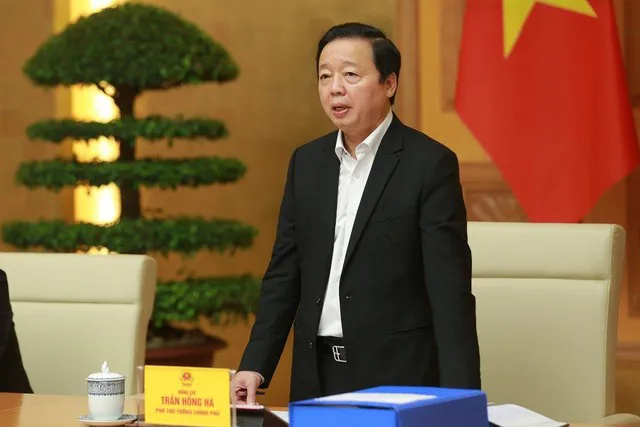
| Deputy Prime Minister Tran Hong Ha at the meeting. Source: VGP |
Minister of Industry and Trade Nguyen Hong Dien commented on March 30 during a meeting of the Appraisal Council for the draft National Petroleum and Gas Reserve Infrastructure Plan.
The minister stated that the country's liquefied petroleum gas (LPG) storage infrastructure is limited, with only ten 10,000 m3 or larger warehouses. Furthermore, no operational liquefied natural gas (LNG) warehouses are nationwide.
"The development of new gas pipelines connecting warehouses to consumers has also encountered challenges due to a lack of designated corridors within industrial parks for gas pipelines," Dien explained.
In the case of petroleum, there is currently no national warehouse system, so reserve petroleum must still be kept at company warehouses, along with a relatively small quantity of finished products, amounting to approximately nine days of net import, he added.
Dien stated that total petroleum reserves (including circulation, production, and national reserves) are roughly 65 days of net imports.
He said the country plans to raise crude oil and petroleum product reserves to 75-80 days of net imports by 2030 and 90 days of net imports by 2050. Gas reserves are also expected to be sufficient for at least 15 days of consumption.
To achieve these targets, Dien believes that a total investment of around VND270 trillion ($11.4 billion) will be required to construct the national petroleum and gas reserve infrastructure system by 2030.
The majority of this financing will be provided by non-budgetary sources, businesses, and other lawful sources. He indicated that capital from the State budget would be prioritized to increase national petroleum reserves.
According to Bui Ngoc Bao, Chairman of the Vietnam Petroleum Association (Vinpa), the petroleum and gas markets are volatile due to variables such as foreign supply and demand, energy conversion, and environmental concerns.
As a consequence, he has emphasized the significance of a dynamic draft master plan that considers the future transition to new fuels.
Dr. Nguyen Anh Duc, Director of the Vietnam Petroleum Institute, has also urged that the strategy be consistent with Vietnam's commitment to reducing greenhouse gas emissions and responding to climate change.
Tran Hong Ha, Deputy Prime Minister, also emphasized the relevance of the national petroleum and gas reserve and supply infrastructure plan, saying that it is critical for ensuring energy circulation.
Ha stressed the importance of the plan in addressing issues such as forecasting market demand and compatibility with land, energy, environment, and urban planning, as well as the need to improve the reserve network's operating, monitoring, management, and coordination mechanisms, as the current national reserve system is insufficient.
The Deputy Prime Minister requested that the MoIT be explicit about the levels in the petroleum and gas supply and storage system, including private, corporate, and national, to have an operating mechanism capable of dealing with volatile market situations without relying solely on the state or specific businesses.
He also stressed the significance of well-defined management and administration mechanisms for the system of private and enterprise stockpiles for business and commercial purposes and the national reserve for emergencies.