Businesses, cooperatives should lead agricultural sector growth: Specialists
Hanoi's agricultural areas are shrinking as five suburban districts are being added to the city.
Hanoi's authorities need to incentivize businesses to get involved in boosting sustainable agriculture, experts gave their opinions at a conference in Hanoi on June 6.
| Rice field at harvest time in Hanoi's Thach That district. Photo: Pham Hung/The Hanoi Times |

Agriculture is a high-risk sector, and it is difficult to gain growth without business cooperation, said former Deputy Minister of Interior Nguyen Tien Dinh.
"The city must provide incentives to encourage investors to pour money into the sector," he said, commenting on the new resolution drafted by the city's People's Council to promote Hanoi's agricultural economy.
"Hanoi should establish integrated agricultural zones that encompass production, breeding, and technological research, supported by a comprehensive and flexible policy framework that focuses on fundamental aspects and promotes integration," Dinh said.
He also called for lawmakers to clarify the hierarchical system so that all departments and agencies are aware of their responsibilities.
According to former National Assembly deputy Bui Thi An, with five suburban districts set to become urban districts, Hanoi's arable land is shrinking.
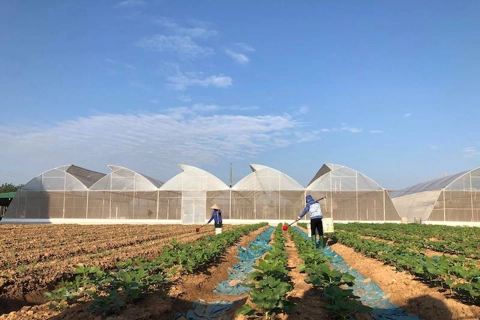
Highlighting the pivotal role of enterprises and cooperatives in the agricultural sector, An emphasized that leveraging technology to enhance productivity and product quality should be their primary focus, accompanied by the need for a financial support package to bolster this production model centered around enterprises and cooperatives.
"It should cover the cooperative's and household's expenses for obtaining certificates, trademark protection, barcode registration, business plan development, and consumption," she added.
Among the immediate priorities, Bui Thi Xo, former director of Hanoi Agriculture and Rural Development, suggested Hanoi identify branded agricultural products, develop raw material areas, acquire new technologies, and strengthen training courses for local people.
She urged authorities to integrate ecotourism into the local agricultural economy to sustain growth.
Nguyen Hung Cuong, an expert from the National Institute of Agricultural Planning and Projection, suggests that Hanoi should initiate a program aimed at enhancing education, preserving traditional handicraft villages, and fostering experiential tourism to stimulate socio-economic growth and enhance residents' living standards.
Hanoi sets ambitious targets for its agricultural sector, envisioning significant advancements by 2025 and beyond, including an average income of VND200 million (US$8,514) per hectare per year, an annual growth rate of 2.5-3%, a minimum of 70% high-tech agricultural products, and 30-40% of the total output generated through association and partnership models.
In addition, animal husbandry is expected to grow by 3-4% per year; at least half of the total output of animal husbandry comes from associated farms, and Hanoi aims to become a high-tech breeding center.
Hanoi plans to invest about VND1.1 trillion (US$46.83 million) in the agricultural sector every year. Of the total, the city and district budgets will provide VND341.6 billion (US$14.5 million), while individuals and organizations will finance nearly VND760 billion (US$33.35 million).