Changes needed for PDP VIII to ensure viable power supply: Trade Ministry
The Ministry of Industry and Trade (MoIT) said it is planning to revise the Power Development Plan (PDP VIII), a little over 15 months after its approval, to ensure a feasible energy supply.
The Ministry of Industry and Trade (MoIT) is seeking feedback from government entities and relevant stakeholders on a draft report to the Prime Minister on adjustments to the National Power Plan until 2030 (PDP VIII), which was approved in May.
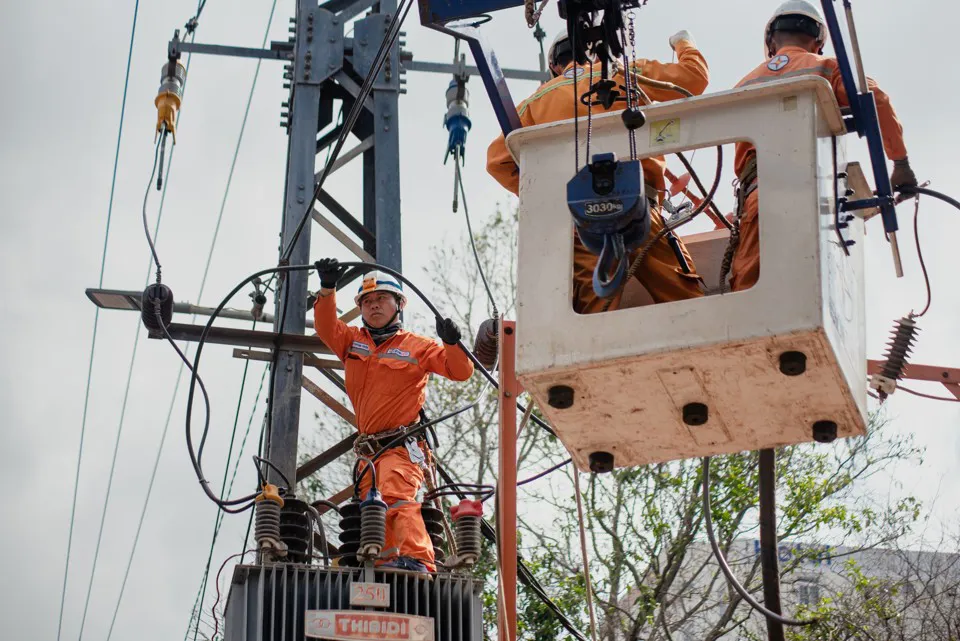
| EVN's workers checking the transmission line in Vietnam's central region. Photo: Hoang Anh/The Hanoi Times |
According to the MoIT, the electricity supply from 2025 to 2030 faces significant challenges, with potential shortfalls in peak capacity during dry seasons. Additionally, the approved power sources are not meeting the planned schedules, raising concerns about future energy shortages. Specifically, the growth rate of commercial electricity nationwide from 2021-2025 is projected at 9.08%, but in the first seven months of this year, demand surged by 13.7%, much higher than the sub-5% growth in the previous period.
As a result, it seems unlikely that the targeted growth rate for commercial electricity will be achieved by 2025. The MoIT emphasizes the need to reassess economic and social conditions to better forecast electricity demand and develop appropriate generation and transmission infrastructure. Many large power projects, particularly those relying on gas and coal, are behind schedule, making revisions necessary to ensure energy security.
For instance, PDP VIII approved 23 gas-fired power projects with a combined capacity of 30,424 MW by 2030. However, only one plant, O Mon 1, is operational, and another, Nhon Trach 3 and 4, is 92% complete and expected to be commissioned in May 2025. Other major projects, such as the Lot B and Blue Whale gas projects, as well as plants like Hiep Phuoc 1, Ca Na, and Nghi Son, are still in the early stages of contracting, financing, or investor selection
The MoIT notes that, with the exception of Nhon Trach 3 and 4, most gas projects are unlikely to be completed before 2030 unless significant obstacles to LNG infrastructure development are overcome. This raises concerns about a large power supply shortfall between 2026 and 2030, particularly in northern Vietnam, posing risks to energy security.
Regarding coal power, the plan envisions 3,380 MW of new coal-fired capacity by 2030, after which coal development will be phased out in line with environmental commitments. However, five coal projects are behind schedule due to issues with shareholder changes and financing, including the 600 MW Cong Thanh, 1,200 MW Nam Dinh I, 1,320 MW Quang Tri, 1,980 MW Vinh Tan III, and 2,120 MW Song Hau II plants. These projects face opposition from local governments and financial institutions due to environmental concerns, making coal expansion less feasible.
Hydropower development also faces challenges, as the capacity available for new projects is limited, increasing the risk of setbacks.
For renewable energy, particularly wind power, achieving the planned capacity is proving difficult. Both onshore and nearshore wind projects were planned for a combined 21,880 MW, while offshore wind projects were projected at 6,000 MW. Solar power capacity is also being reassessed to bring it into line with actual conditions.
Given the delays in major power projects (coal, gas), the MoIT suggests expanding centralized solar power projects, which can be developed quickly to meet future electricity demand. The current plan includes 12,836 MW of centralized solar capacity, increasing to 168,594-189,294 MW by 2050. However, only 1,500 MW of additional solar power is planned through 2030.
Other power sources may also be prioritized in the revised plan. For example, biomass and waste-to-energy projects were allocated 2,270 MW by 2030 in the original plan, but many localities are proposing to expand these projects to help address environmental issues. The Ministry believes these energy sources should be prioritized for stronger development.
In addition, pumped-storage hydropower, battery storage, and electricity imports from Laos are seen as essential to meeting future energy demand and mitigating the risk of shortages.