14TH NATIONAL CONGRESS OF THE COMMUNIST PARTY OF VIETNAM
Log in
Property

Covid-19 exerts insignificant impacts on Vietnam residential market in short term

The situation, however, is likely to be getting worse if the pandemic derails the economy, due to the highly cyclical nature of the real estate industry.

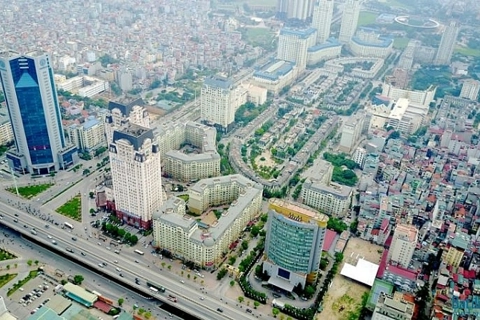
Although Vietnam’s economy is under huge pressure from the Covid-19 pandemic, especially in industries related to trade and transportation, the impact on the residential market is not clear in the short term as demand depends on the homebuyer’s long-term plan, according to Viet Dragon Securities Company (VDSC).
 

However, the situation is likely to be getting worse if the pandemic derails the economy, due to the highly cyclical nature of the real estate industry. Moreover, the percentage of buyers investing and speculating in projects in Vietnam is also relatively high, leading to the negative sentiment, said VDSC in its latest report.

The bright spot is recent positive news, which should help the market partly solve the “legal bottlenecks.”

Thereby, it will help increase supply to the market. In addition, investors also expect the stimulus package in 2020 to support the economy, especially the implementation of public investment projects, which strongly support real estate demand. Real estate developers in general will benefit from this trend. It is also considered an opportunity for good companies with healthy cash flow to capture more market share.

Specifically, Decree No.25, which allows land to be allocated to winning bidders immediately after completing the compensation process, is expected to facilitate the resumption of a number of infrastructure projects. Recently, the Ho Chi Minh City People’s Committee announced that it will re-start a number of infrastructure projects in the Thu Thiem New Urban Area, while there has been progress in major infrastructure projects likes Long Thanh airport and Bien Hoa-Vung Tau expressway.

A look at real estate market in 2019 and 2020

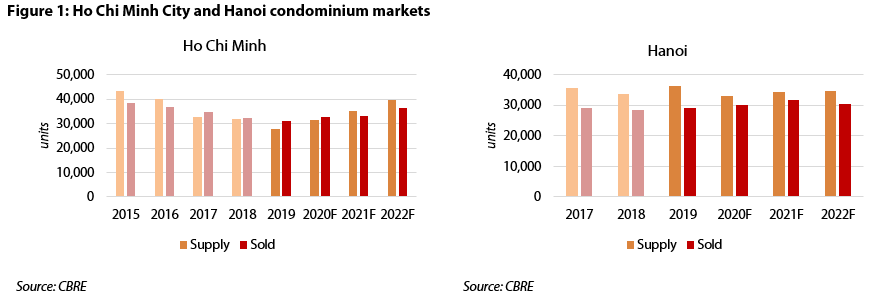
2019 closed with the lowest amount of supply during the last five years in the Ho Chi Minh market, down 16% year-on-year, while Hanoi launched the highest number of units in the last three years, up 7%. The difference between the two key markets is that the absorption rate in Ho Chi Minh has been higher than in Hanoi, as it was the third consecutive year that demand exceeded supply, contrary to the Hanoi market.

In 2020, CBRE predicted a 15% increase year-on-year in the supply in the Ho Chi Minh City market, thanks to the expectation of loosening legal processes. Meanwhile, the Hanoi market will suffer a decline of 17%, due to the reduction of supply from large-scale projects of developer Vinhomes.

Reactions:
Share:
Trending
Most Viewed
Related news
Tet renovation rush strains Hanoi crews, lifts finishing material costs prices

Tet renovation rush strains Hanoi crews, lifts finishing material costs prices

Hanoi’s home renovation market has entered its busiest stretch of the year, as year-end demand tightens contractor availability and raises the cost of finishing materials.

Vietnam construction materials rebound as prices rise and public investment accelerates

Vietnam construction materials rebound as prices rise and public investment accelerates

Rising steel and cement prices, stronger public investment spending and improving consumption across key material segments point to a broad recovery in Vietnam’s construction materials sector as 2026 begins.

Hanoi sets 40 sq.m housing space goal to lift urban living standards

Hanoi sets 40 sq.m housing space goal to lift urban living standards

Raising average housing space marks a people-centered shift in urban policy as the capital works to improve living standards, expand social housing and ensure that rapid economic growth goes hand in hand with safer and more livable neighborhoods.

Prime Minister urges measures to boost supplies and control house prices

Prime Minister urges measures to boost supplies and control house prices

Vietnam’s government is stepping up efforts to rebalance the real estate market as Prime Minister Pham Minh Chinh urges faster policy action to expand housing supply, address affordability pressures and ensure the sector supports both economic stability and social welfare.

Ho Chi Minh City forms first professional association for apartment management

Ho Chi Minh City forms first professional association for apartment management

Amid rapid urban growth, Ho Chi Minh City has established a professional body for apartment management, becoming the first locality in Vietnam to do so.

Real estate credit surge prompts tighter oversight to safeguard Vietnam’s financial stability

Real estate credit surge prompts tighter oversight to safeguard Vietnam’s financial stability

Vietnam’s real estate sector has absorbed a sharp rise in credit, supporting market recovery while raising concerns over capital concentration, speculative risks and the need for tighter policy coordination.

Revised housing roadmap doubles social housing targets for Hanoi

Revised housing roadmap doubles social housing targets for Hanoi

Vietnam’s push to accelerate affordable housing has significantly raised expectations for major cities, with Hanoi now tasked with delivering a far larger volume of social homes as part of the national goal to build more than one million units by 2030.

Social housing supply exceeds targets in 2025 as Vietnam tackles property imbalances

Social housing supply exceeds targets in 2025 as Vietnam tackles property imbalances

Vietnam surpassed its social housing construction target in 2025, marking progress in housing policy, but supply mismatches, high prices and legal bottlenecks continue to weigh on the real estate market.