Durian needs to become national product: Minister
Vietnam is currently lagging behind Thailand and Malaysia in durian exports to China.
Vietnamese Minister of Agriculture and Rural Development Le Minh Hoan emphasized that setting standards and protecting the brand value is essential to expand the reach of Vietnamese durians internationally to ensure it is on par with Thai and Malaysian durians.
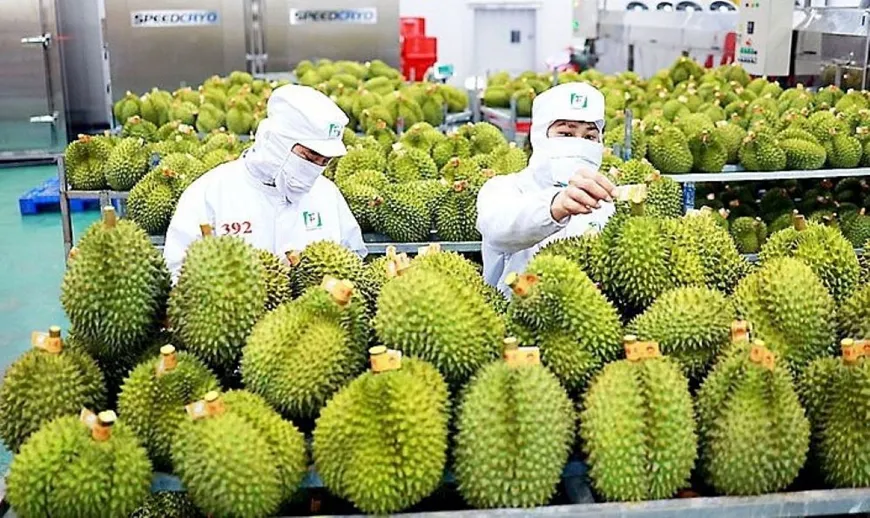
| Processing durians for exporting to China. Photo: The Hanoi Times |
During the interpellation session at the National Assembly Standing Committee on August 21, Deputy from Binh Phuoc Province Huynh Sang questioned Minister Hoan on Vietnam’s agricultural export strategy. She pointed out that while cashew exports reached US$3.6 billion last year and durian prices have consistently hit record highs with over 150,000 hectares under cultivation, the development and protection of Vietnamese agricultural brands remain inadequate.
Sang noted that there is currently no significant difference between durians purchased with or without a production area code, which impacts farmers' interests and sustainable cultivation. She urged the Minister to propose solutions to safeguard the brand value of cashew and durian and protect the raw material regions.
Deputy Pham Hung Thang from Ha Nam also requested the Minister to clarify the strategies for supporting the production, consumption, and market expansion of Vietnamese agricultural products.
In response, Hoan mentioned that the Ministry recently signed the second protocol on processed durian products, including durian pulp, seeds, and frozen durians, which facilitates market access for Vietnamese durians in China.
He noted that building a strong brand for Vietnamese agricultural products can significantly increase their value. However, this task faces numerous challenges.
“There is still confusion among people and businesses between trademarks and brands. While trademarks are built and protected, a brand represents consumer trust in the quality, standards, and consistency of a product,” Hoan said.
According to Hoan, the Ministry of Agriculture and Rural Development, in collaboration with the Ministry of Industry and Trade, is working on establishing brands for agricultural products. To achieve this, concentrated raw material areas need to be developed to ensure standardized, uniform products and key agricultural products must be regulated. Structures also need to be established to protect the image of Vietnamese agricultural products in the international market, he said.
Hoan also emphasized that protecting brand value requires setting standards, forming industry associations, and fostering links between farmers, associations, and enterprises. He underscored the importance of transforming durian into a national product and developing a comprehensive policy for durian that encompasses farmers, businesses, science and technology, and infrastructure. Vietnam is currently lagging behind Thailand and Malaysia in durian exports to China.
However, the standardization of agricultural products remains a challenge, especially given Vietnam’s fragmented and small-scale, spontaneous agricultural practices. The Minister argued that without meeting market standards, Vietnam's products cannot be competitive. Therefore, solutions such as issuing codes for production areas and zones are crucial.
To address the fragmentation in agriculture, Hoan highlighted the need to consolidate raw material areas and form strong cooperatives. The Ministry plans to develop policies to combine small plots into larger ones and small forests into larger ones, with more support needed from local authorities.
According to Dang Phuc Nguyen, Secretary General of the Vietnam Fruit and Vegetable Association, frozen durian was previously exported mainly to Thailand, the US, and Europe, with an annual export value of several hundred million USD. With the Chinese market now more accessible, durian export turnover is expected to surge.
“If the Chinese market shifts to frozen durian consumption, Vietnam will gain a significant competitive advantage,” he said.
Last year, Vietnam exported around 500,000 tons of fresh durian, generating $2.3 billion in revenue, with 90% of this exported to China. The area under durian cultivation is 154,000 hectares, with an annual growth rate of 15%. In addition, Vietnam is one of the world's largest producers and exporters of coconut, with 175,000 hectares under cultivation, mainly in the Mekong Delta.
With the opening of the Chinese market, frozen durian exports are expected to reach $400-500 million this year, and fresh coconut exports to increase by $200-300 million. This will not only bring economic benefits but also promote sustainable development and enhance the quality of Vietnam's agricultural products.