Hanoi promotes concentrated agricultural areas
Hanoi's focus will be on the development of high-tech agriculture and farm-based production in conjunction with eco-tourism.
Localities in Hanoi focus on expanding large-scale, high-value agricultural areas and building value chain links to increase economic value.
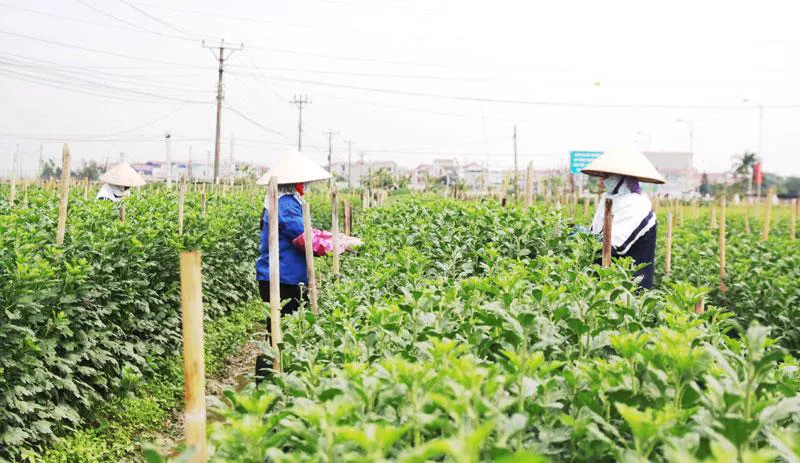
| Growing chrysanthemums at Me Linh District. Photo: Trong Tung/The Hanoi Times |
Yen My Commune is ideal for vegetable farming because it is on the flat ground beside the Red River. To enable farmers to adopt high-tech production techniques, the commune has devised a plan to establish a 91-hectare concentrated vegetable growing area.
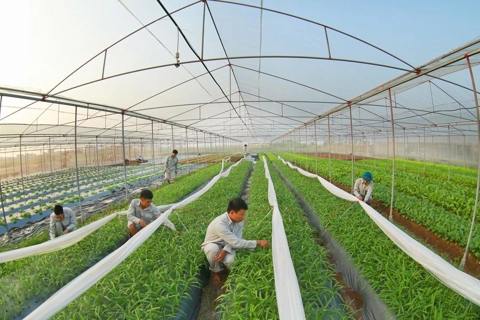
The 2.5-hectare hydroponic vegetable greenhouse that the cooperative currently runs in Yen My Commune produces more than seven tons of different vegetables each year, according to Nguyen Manh Hong, the cooperative's director.
Hong said melons are now being grown in the cooperative's greenhouses on a 1,000-square-meter plot, with an output of about 2.4 tons per crop and a profit of VND70 million.
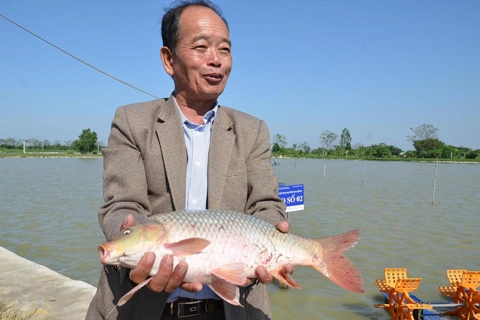
Meanwhile, Vice Chairman of Thuong Tin District People’s Committee Bui Cong Than said the locality had established concentrated and large-scale agricultural production areas, including 545 hectares of safe vegetable production, 1,159 hectares of aquaculture, and 1,745 hectares of commodity rice production.
Furthermore, the district has created 15 models of high-tech agriculture, organic agricultural production, and clean agriculture in addition to 14 chain linkage models for farming, livestock husbandry, and slaughter, Than added.
The agricultural and rural areas have been divided into various ecological sub-regions based on their topographical features as part of the city's agricultural restructuring plan for the years 2022–2025. To promote commodity-intensive production, more than 40,227 hectares of rice fields have been transformed into new agricultural models, including 35 rice-growing regions, 104 vegetable-growing regions, 56 fruit-tree regions, six tea-growing regions, and 66 aquaculture zones. In addition, there are 48 concentrated breeding areas outside of residential neighborhoods with 3,800 large-scale farms.
| Model of cultivating hydroponic vegetables in Thanh Tri District. Photo: The Hanoi Times |
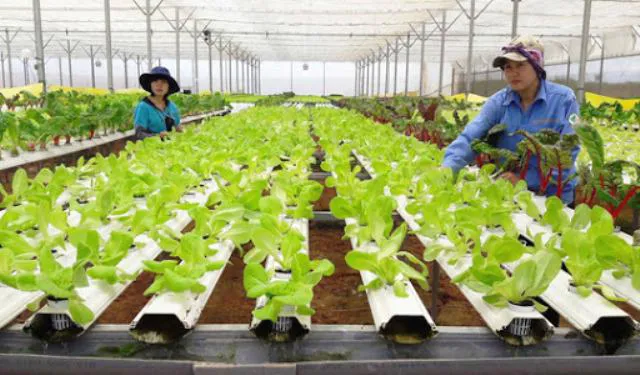
The establishment of these agricultural commodity areas, according to Ta Van Tuong, deputy director of the Hanoi Department of Agriculture and Rural Development, has given businesses and cooperatives a chance to apply scientific and high-tech advances in safe and environmentally friendly production, producing goods with high productivity, quality, added value, and competitiveness, which ensure efficiency and sustainability.
Tuong pointed out, however, that there are still some issues with the expansion of concentrated production areas, such as the slack implementation of production area planning and insufficient infrastructure investment in some localities.
Furthermore, according to Tuong, only a few production areas adhere to VietGAP and organic standards, making the farming industry still small and fragmented.
The agricultural land area is gradually shrinking as the district transforms into an urban area, according to Nguyen Van Hung, the vice chairman of the Thanh Tri District People's Committee, and workers shift from agriculture to the service and industrial sectors. Four agricultural production areas with unique advantages, including the cultivation of fruit trees, safe vegetable cultivation, high-quality rice cultivation, and aquaculture, have been planned by the district to solve this problem.
To produce high-quality goods that meet consumer demand, "the district also aims to create favorable conditions for businesses and cooperatives to apply high technology to production," Hung added.
"The city will focus on developing high-tech agriculture and farm-oriented production related to ecotourism by investing in infrastructure in conversion areas, supporting product production, and effectively utilizing the land area of the Red River, Da River, Day River, and Duong River. We also plan to strengthen the application of artificial intelligence in the production, management and distribution of agricultural products and build value chains for key agricultural products," Tuong said.
Nguyen Thi Lan, Director of the Vietnam Academy of Agriculture, added that to plan agricultural land by Hanoi's development conditions, it is necessary to adhere to the criteria of urban agriculture development, especially ecological urban agriculture combined with tourism development, and to prioritize environmental protection and preservation of green belts.
"Hanoi should also prioritize concentrated and focused scientific research, combined with the transfer and application of new and advanced technologies and digital transformation. These are seen as drivers and effective solutions to ensure the success of agricultural restructuring through a shift from high-yield agriculture to high-value, efficient agriculture," Lan said.