Hanoi's thriving tea industry faces challenges in boosting exports
Hanoi currently has over 2,000 hectares under tea cultivation, mainly in the mountainous and hilly terrains, with an annual production of over 20,000 tons.
Despite Hanoi's considerable tea acreage and production, it hasn't made enough money from exports, so the city's agriculture sector needs a plan to replant tea and boost exports, according to the Hanoi Department of Agriculture and Rural Development.
Machining limitations
| VietGAP standard tea growing model in Ba Trai Commune. Photo: Hanoimoi Newspaper |
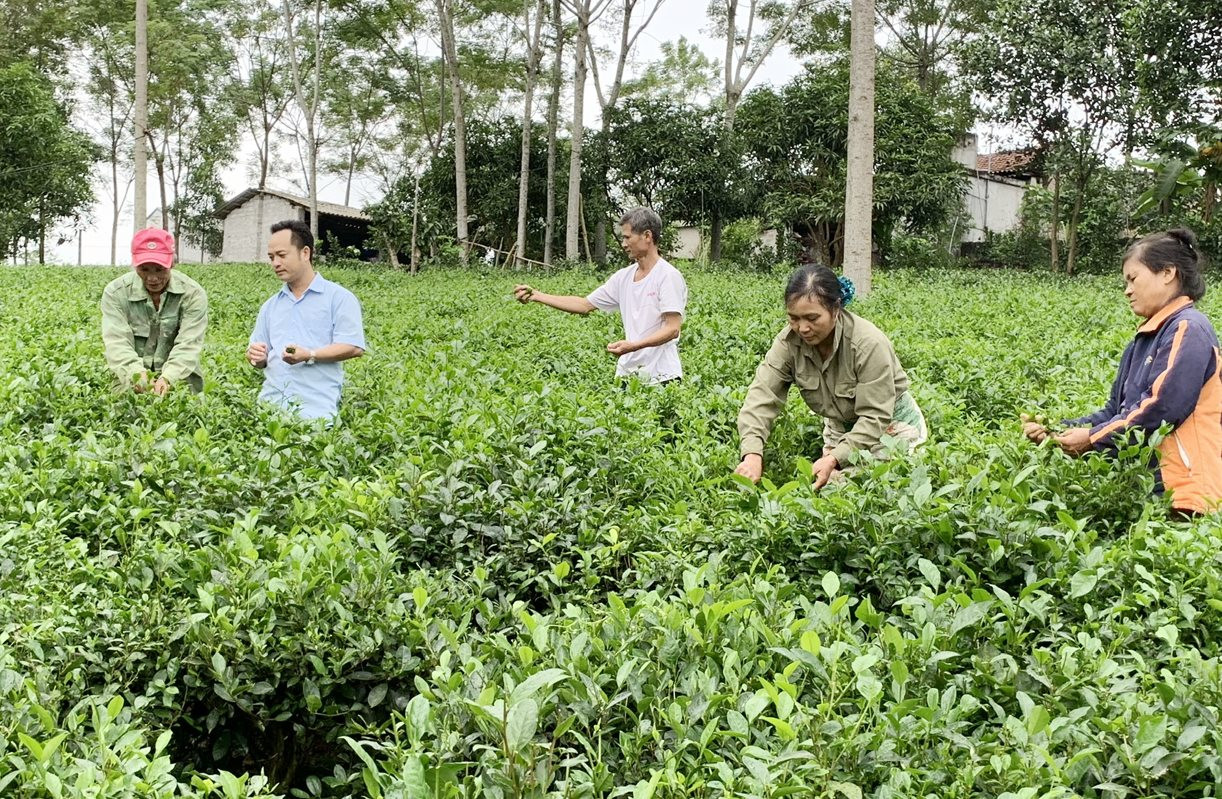
Ba Trai Commune (Ba Vi District) is known as the main tea-growing area of Hanoi. With suitable climate and soil conditions, tea plants grown in the hills of Ba Trai are highly regarded for their natural fragrance and distinctive rich flavor.
Nguyen Ta Tan, Vice Chairman of Ba Trai Commune People's Committee, said that with more than 470 hectares of tea, Ba Trai is the commune with the largest tea acreage in the city.
He added that nine out of ten villages in Ba Trai have been recognized by Hanoi as traditional villages for dry tea bud processing. The average tea yield in Ba Trai is 8.5 tons per hectare, with the total annual tea production of the commune exceeding 5,000 tons.
Dry tea buds from Ba Trai are sold at prices ranging from VND300,000 (US$12) to VND500,000 ($20) per kilogram, generating an income of about VND300 million ($12,000)/hectare per year. Ba Trai tea products are distributed in provinces and cities nationwide, Tan said.
"Ba Trai tea is grown in accordance with the VietGAP standard, which is a guarantee of food safety, hygiene, and environmental protection. In 2021, the Ba Trai clean tea product was recognized as a three-star One Commune One Product (OCOP) standard," he said.
However, tea growers in Ba Trai still have many concerns when it comes to exporting tea, said Dinh Cong Phu, Chairman of the Ba Trai Commune Farmers' Association, adding that Ba Trai farmers want to bring Ba Trai tea to the global market.
"If high technology is applied in production, especially in pre-processing and processing, Ba Trai tea can definitely be exported. Some Ba Trai teas are even considered as delicious as the specialty teas of Ha Giang and Thai Nguyen provinces," he said.
Hoang Thi Hoa, Director of the Hanoi Agricultural Development Center, said that despite the large total area, tea production in localities is small-scale, averaging 0.1-0.2 hectares per household, making it difficult to apply new and modern technical equipment and obtain product safety certification.
In particular, investment in infrastructure and the application of high technology in tea production is still scarce. In the whole city, only 356 out of 2,005 hectares of tea have applied high technology in production, accounting for about 10.2% of the area.
Among them, 30 hectares are comprehensively using high-tech; 186 hectares are adopting new, high-value, and high-quality varieties; 90 hectares are applying biological, organic fertilizers and herbal medicines; and 30 hectares are installing water-saving irrigation technology, Hoa said.
Currently, there are only the tea regions of Bac Son (Soc Son District) and Long Phu (Quoc Oai District) in Hanoi that export to Russia, Taiwan (China), and the Middle East, but in modest quantities, according to the center's director.
Replanting with new tea varieties
| Tea harvest by farmers in Bac Son Commune. Photo: Trong Tung/The Hanoi Times |
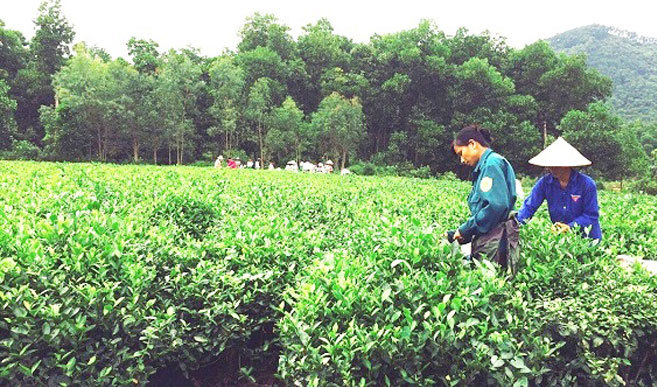
Commenting on Hanoi's tea growing potential, Hoang Vinh Long, Secretary General of the Vietnam Tea Association, said that Hanoi can fully develop tea for export. The city's tea production currently reaches over 20,000 tons per year, accounting for about 16-18% of the country's total.
He added that tea is mainly grown in hilly and mountainous areas with suitable climate and soil conditions. Many tea-growing areas in the capital are also linked to the development of eco-tourism, which helps promote Hanoi's tea products. However, in order to enter the global market, the capital's tea needs to be extensively replanted.
"Tea plants typically have a productive life of about 20-30 years. However, most of Hanoi's tea gardens are now over 30 years old. Therefore, they need to be renovated and new tea varieties need to be introduced into production," he stressed.
Nguyen Xuan Dai, Director of Hanoi's Department of Agriculture and Rural Development, said Hanoi will preserve traditional tea-growing areas with high potential.
He added that the agriculture sector will coordinate with local tea-growing areas to develop a plan for tea replanting and establish one or two tea material production areas that meet export standards. The city will also liaise with enterprises to introduce modern technology in tea processing and boost exports.
"The agriculture sector needs to help tea farmers adopt modern farming methods and meet quality standards, while also undertaking tea replanting efforts. In particular, branding, area codes, and quality are also issues that need to be thoroughly discussed in the replanting process," emphasized Dai.