Inflation not a source of concern for Vietnam: SSI
Vietnam’s consumer price index (CPI) is set to average 2.89% in 2021, below the government’s target of 4%.
Inflationary pressure has forced central banks around the world, including those from Russia, Brazil, or Turkey, to raise their respective policy rates in the first quarter, but in case of Vietnam, inflation should not be a source of concern, according to SSI Securities Corporation (SSI).
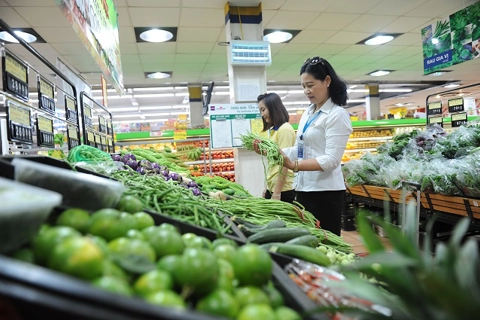
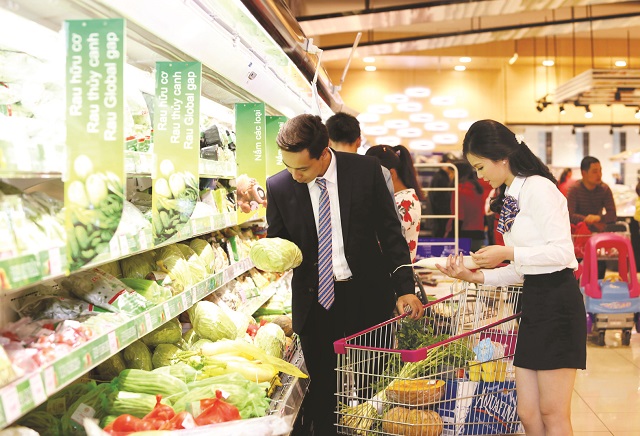
| Customers at a super market in Hanoi. Photo: Pham Hung |
In the global scale, the expansion of money supply is a common solution as governments turn to stimulus measures to aid economic recovery from the Covid-19 pandemic.
However, “the fact such approach has been adopted for over a year and the prospect of V-shaped recovery after the pandemic is contained globally leads to inflation rise,” said the SSI in a note, adding inflation could cut short the super-easing monetary period worldwide.
In Southeast Asia, countries such as Thailand, Singapore, Indonesia and Malaysia have pushed for strong expansion of money supply since March, but the State Bank of Vietnam (SBV), the country’s central bank, continued to keep the growth rate of M2 (measures money supply that covers cash in circulation and all deposits) at a round 13-14% year-on-year, which is in line with the credit growth.
Since the beginning of the year, the SBV has lowered its interest rate cap three times by a combined of 1.5-2 percentage points per annum, which is the largest cut in the region, but has not opted for pumping additional money via open market operations (OMO).
According to the SSI, the amount of cash injected into the market last year was mainly from foreign exchange transaction to build up foreign exchange reserves, while there were no cash pumped into the market via OMO and foreign exchange transaction since early 2021.
“This shows the government’s cautious approach in managing monetary policy,” stated the SSI.
In March, Vietnam’s consumer price index (CPI), the main gauge for inflation, declined by 0.27% month-on-month and up 0.29% year-on-year, the lowest growth rate for the past 20 years.
This resulted in a decline of 0.12% month-on-month in the inflation rate in March, marking an overall growth of 0.67% in the rate for the first three months of the year.
“We expected the CPI as of late 2021 to expand by 4.07% against the same period of last year, and average 2.89% for the whole year, which is below the 4% target set by the government,” said the SSI.
In a recent move, the SBV has assigned the credit growth target for state-owned commercial banks of 6.5-7.5% (except for Vietcombank at 10.5%), and private banks from 8-12%, which the SSI said are in line with the country’s target for credit growth of 12% in 2021.
For short-term, the SSI expected the SBV to maintain its low-interest rate environment, but deposit rates are set to rise by 0.3-0.5 percentage points in late 2021 as economic activities heat up.
While Vietnam’s GDP growth in the first quarter reached 4.48% year-on-year, lower than SSI’s estimated 4.5-5%, the securities firm predicted the country’s economic growth would hit its yearly peak in the second quarter and settle at 6-6.5% for the year.