“More from less” – sustainable agricultural model for Vietnam
Vietnam will intensify investment in eco-farming, low-carbon and high-tech cultivation as sustainable agriculture and food security are the pillars of its development strategy by 2030.
Vietnam said it’s necessary to promote green agriculture with “more from less” approaches to ensure better value chain amid increasingly global linkage.
| Le Quoc Doanh, Deputy Minister of Agriculture and Rural Development, speaks at the FAO's Asia-Pacific Symposium on Agrifood Systems Transformation (APSAST). Photo: Linh Linh |
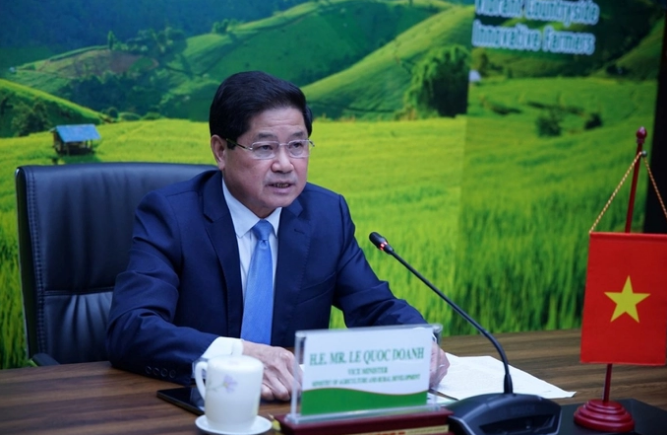
Deputy Minister Le Quoc Doanh of Vietnam’s Ministry of Agriculture and Rural Development (MARD) said at the hybrid Asia-Pacific Symposium on Agrifood Systems Transformation (APSAST) held on October 5-7.
Vietnam added its voice to that of Asia-Pacific countries in a major gathering to rapidly transform the region’s agriculture and food systems, which are damaged by Covid-19, climate change, and price spikes.
Doanh highlighted Vietnam’s experiences in moving forward on a vital agrifood system transformation, together with the regional and the world, to achieve the global Sustainable Development Goals by 2030.
Doanh said that sustainable agriculture and food security are the pillars of Vietnam’s Socio-economic Development Strategy for 2021-2030, focusing on eco-farming, low-carbon and hi-tech agriculture coupled with better livelihoods for farmers.
“We are dedicated to transforming the food and food system in the direction of accountability, transparency, and sustainability,” he noted.
To boost global connection in the value chain, the Government of Vietnam emphasizes collaboration among nations in agriculture to make significant changes in the worldwide system toward eliminating hunger and reducing poverty, food security and nutrition for rural residents, especially vulnerable groups.
Regarding the issue, he called for uninterrupted collaboration in the global agricultural supply chain by removing barriers in production and transaction while boosting e-commerce and facilitating logistics for better quality control.
He also underscored the importance of the private sector in public-private partnerships (PPP) in agriculture while stressing the need for joint efforts in research, early warning of natural disasters and epidemics, and exchange of information on natural resources and transboundary water resources, as well as the need to strengthen South-South collaboration.
The Vietnamese official emphasized that the countries should strengthen cooperation to promote the sustainability and adaptation of national agri-food systems in which farmers, producers, processors, distributors and consumers are at the center.
| FAO's Asia-Pacific Symposium on Agrifood Systems Transformation (APSAST) addresses 5F (food, feed, fuel, fertilizer and finance) crisis. |
.jpg)
Time for Asia-Pacific to accelerate agrifood system transformation
Convened by the Food and Agriculture Organization of the United Nations (FAO), APSAST has brought together all regional stakeholders to map out a massive acceleration to transform agrifood systems. It also addresses the risk of worsening malnutrition and further environmental degradation in the world’s hungriest and most populous region.
At the event, the participants debated the twin shocks of the Covid-19 pandemic and the 5F crisis (food, feed, fuel, fertilizer and finance), which have shown structural weaknesses and low levels of resilience in the regional agrifood systems.
More than 80% of the world’s smallholders and family farmers live off the land in Asia-Pacific, and their interests and livelihoods must be safeguarded, according to experts at the Symposium.
“It’s time that all stakeholders in this region made bold moves toward this transformation of our food and agriculture systems,” said Jong-Jin Kim, Assistant Director-General and FAO Regional Representative for Asia and the Pacific.
He added that governments must act through leadership while the private sector must broaden its customer base to provide affordable solutions to the region’s smallholders. At the same time, civil society needs to work more proactively with policymakers and the private sector. Research institutions should accelerate their research, while resource partners must make this transformation their top priority.
To improve regional resilience, Vietnam will chair the 4thh conference of the Sustainable Food System (SFS) in April 2023 within the framework of the One Planet Network.
In Hanoi, the capital city of around 7.5 million people, agriculture is crucial to supplying the growing demand for agricultural products, especially organic ones. The local authorities has worked to integrate the city's agriculture with cutting-edge sustainable development. The local government has released a strategy for sustainable agricultural development from 2022-2030, with a vision for 2050, focusing on developing modern, clean, and organic agriculture. This strategy is based on the view for the development of agriculture toward eco-urban agriculture in attachment to services, tourism, and mass production of goods with high productivity, quality, and efficiency. The agro-forestry-fishery sector's gross regional product (GRDP) growth rate will average 2.5–3% per year by 2030, and labor productivity will rise by 7.5%–7.5%. By 2030, the capital hopes that high-tech agricultural goods will make up more than 70% of agricultural output. Hanoi will build new production organization structures, implement and manage planning effectively, and encourage the study, use, and transfer of science and technology to innovate and increase the capacity and efficiency of state management. Accordingly, the city will focus on developing infrastructure, promoting digital transformation in rural areas, and boosting trade promotion of agricultural products. At the same time, it will also improve global market development capabilities and accelerate the timely and effective implementation of policies on agricultural production. |