Reforms to ensure higher economic growth as Vietnam’s population ages
Vietnam’s labor force is projected to contract by almost one percent per annum over the next three decades, creating headwinds to sustaining high economic growth rates.
Vietnam’s economic growth could slow as its population ages, squeezing public finance and stressing the service delivery system, unless timely reforms are set in motion, a new World Bank report finds.
| Production at Foxconn in Dinh Tram Industrial Park, Bac Giang Province. Photo: Giang Son Dong |

Vietnam is going through the demographic transition to an older society at an earlier stage of economic development and a lower level of per capita income than other countries that have experienced a similar shift, according to Vietnam: Adapting to an Aging Society, jointly produced by the World Bank and the Japan International Cooperation Agency (JICA).
The report noted Vietnam’s labor force is projected to contract by almost one percent per annum over the next three decades, creating headwinds to sustaining high economic growth rates.
Under this circumstance, the prospect of “getting old before getting rich” means that Vietnam faces a set of important challenges whose solutions require making hard policy choices.
“Vietnam has been good at tapping into an abundant workforce to drive economic growth over the past three decades,” said Carolyn Turk, World Bank Country Director for Vietnam. “As Vietnam’s population ages, it will be important to build the skills of the workforce to boost innovation and productivity in the economy, while ensuring that pension reforms begin now to sustain livelihoods for the elderly in the decades to come.”
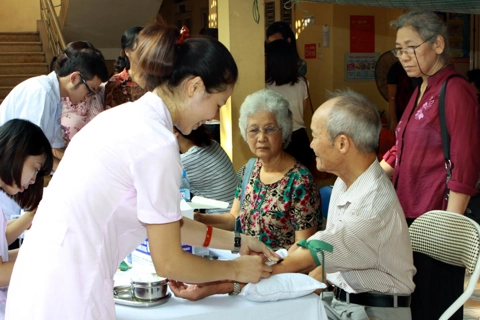
With falling birth rates and a rising life expectancy, Vietnam’s elderly is expected to account for between 10% to just under 20% of its population by 2035. Vietnam’s old-age dependency ratio, the number of people over 65 divided by the number of those of working age, is estimated to double from 0.11 in 2019 to 0.22 in 2039.
The report finds that long-term growth over the period 2020–2050 will slow by 0.9 percentage points compared with the last 15 years as its population ages. At the same time, addressing the needs of an aging society is forecast to cost between 1.4% to 4.6% of GDP in additional expenditure. Expanding coverage and improving service quality will drive growth in fiscal costs.
The report offers recommendations on how Vietnam can manage the aging of its population effectively, based on lessons learned in other countries that have experienced a similar demographic transition including Japan, in particular. It suggests reforms to help improve labor force participation and productivity, increase the efficiency of public expenditures, and strengthen the service delivery system.
The report also recommends policy actions in four areas most affected by the aging trends: labor market, pension, health, and aging care.
“Productivity can be raised both by accelerating the movement of workers from low to higher productivity sectors as well as through boosting human capital,” noted the report, while stressing that encouraging people to continue working even when they grow older can also help compensate for the shrinking labor force.
“Since becoming a super-aged nation in the 1960s, Japan has experienced various implications of aging, particularly those related to adjusting social protection programs and promoting community-based care,” said Shimizu Akira, Chief Representative of JICA Vietnam Office. “There have been a lot of successes, and also many bitter experiences. We hope these shared lessons will be useful for Vietnam to not only cope with the demographic shift but also to benefit from it.”
The report is a part of a JICA and World Bank joint program to assist Vietnamese policy-makers in preparing for an aging society.