Log in
Business

Struggling to balance State budget

The State budget collection this year is projected not to reach the estimate amid rising expenditure and declining fees and charges.

The Vietnam's January-September budget revenue was estimated at 64.5% of the yearly target, making a year-on-year decrease of 11.5% to touch VND975.3 trillion.

The projected number for the whole year is more than VND1.3 quadrillion, deficiency of VND189.2 trillion (down 12.5%) against the yearly estimate.

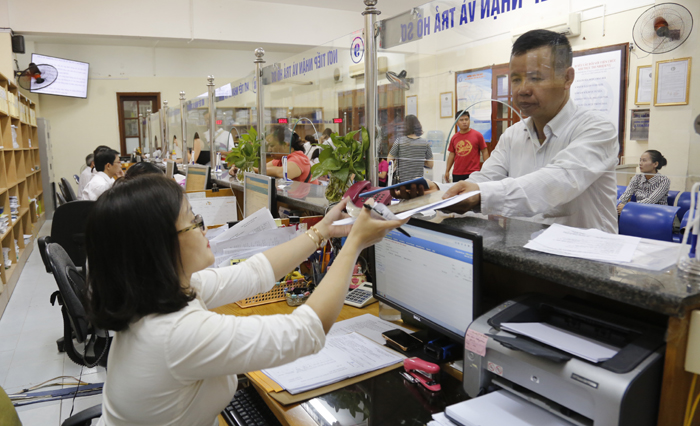
 Tax declaration at Hanoi's Department of Taxation. Photo:Khanh Linh. 

The Covid-19 pandemic has derailed Vietnam’s economic growth this year. Other factors such as declining oil prices and slow progress of equitisation and divestment of state-owned enterprises also affected revenues from taxes, fees and crude oil export which make collection fail to meet the National Assembly’s projection.

Revenue from crude oil in the past nine months was estimated at VND27.5 trillion, equal to 78.2% of the estimate and down 36.9% from the same period of last year.

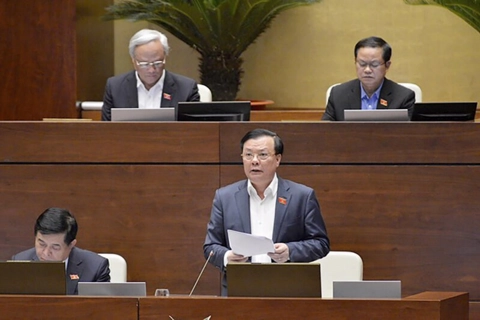
“Meanwhile, the budget deficit is forecast to rise sharply due to the adjustment of revenue policy to tackle difficulties for businesses. At the same time, expenditure for disease prevention and control, ensuring social securities and boosting consumption demand… is great, making budget deficit inevitable,” said Minister of Finance Dinh Tien Dung.

The State budget deficit in 2020 is projected at 4.99% of GDP, up 1.55% over the estimate.

The Ministry of Finance (MoF) said balancing the central budget and local budgets at all levels is difficult in the context of shrinking revenue.

As of September 25, the ministry issued VND223.34 trillion worth of government bonds as planned for 2020, in which spending for paying due bond debts and receiving debts with Vietnam Social Securities was nearly VND9.9 trillion.

Worry about repayment

Forecasts show by year-end 2020, debt-to-GDP ratios will basically remain within the safety thresholds set by the National Assembly (NA). However, NA has warned the Government’s direct debt obligation has reached the ceiling of 25% of the total budget revenue in 2020 and is expected to exceed this rate in 2021 which can put it at risks next year.

Under this circumstance, MoF has directed to tackle revenue problems such as strengthening revenue management, reducing revenue loss, fighting against smuggling, trade fraud and price transfer, and reducing tax arrears. At the same time, it will review the state of tax debts of its sub-departments; classify debt groups that can be collected and irrecoverable.

MoF estimates revenues from equitisation and divestment may reach more than VND45 trillion if authorities at all levels drastically put things on the right track along with recovery of the financial and stock markets.

Dr. Vu Dinh Anh said besides restructuring revenue we must also control spending towards more rationally and efficiently such as streaming payrolls, reforming recurrent expenditure and management and use of public asset.

Reactions:
Share:
Trending
Most Viewed
Related news
Hanoi advances hi-tech industry, with Hoa Lac as its key growth engine

Hanoi advances hi-tech industry, with Hoa Lac as its key growth engine

Hanoi is accelerating its shift toward a modern industrial model built on high technology and innovation, with Hoa Lac emerging as the core destination for investment and high-quality human resources.

Hanoi pushes SME–large enterprise linkages to drive sustainable supply chain growth

Hanoi pushes SME–large enterprise linkages to drive sustainable supply chain growth

Experts have said that the city can strengthen its competitiveness by deepening cooperation among the Government, large enterprises, and small businesses, especially through more effective supply-chain linkages.

Hanoi’s Hi-tech & Industrial Parks: achievements and outlook

Hanoi’s Hi-tech & Industrial Parks: achievements and outlook

Hanoi’s hi-tech and industrial parks are emerging as key drivers of the capital’s economic transformation, attracting high-value investment, advancing innovation and strengthening supply chains as the city sets its sights on becoming a leading regional technology and manufacturing hub.

Vietnam honors 50 transparent listed companies as stock market reaches new milestones

Vietnam honors 50 transparent listed companies as stock market reaches new milestones

Vietnam honored 50 listed companies for excellence in transparency at the 2025 Vietnam Listed Company Awards, which spotlighted standout annual reports, corporate governance and sustainability disclosures amid rising foreign investor interest and growing alignment with international reporting standards.

Vietnam to tighten biometric authentication for new bank cards next year

Vietnam to tighten biometric authentication for new bank cards next year

Bank card issuers must conduct a face-to-face meeting and match the biometric data of individual customers or the legal representative of organizational customers with their identity documents.

Make in Vietnam forum spotlights breakthroughs shaping digital future in the country

Make in Vietnam forum spotlights breakthroughs shaping digital future in the country

Vietnam will host the seventh National Forum on Vietnamese Digital Technology Enterprises on December 25 in Hanoi, highlighting policy directions, strategic technologies and progress under the “Make in Vietnam” initiative as the country pushes toward a stronger digital economy.

Hanoi and Moscow seek new economic momentum as partnership marks 75 years

Hanoi and Moscow seek new economic momentum as partnership marks 75 years

At the Moscow–Hanoi Business Forum, leaders from both capitals said 75 years of Vietnam–Russia ties provide a strong foundation to deepen economic and investment cooperation, especially in technology, trade and urban development.

Vietnam manufacturing maintains strong momentum despite storms disrupting supply chains

Vietnam manufacturing maintains strong momentum despite storms disrupting supply chains

Vietnam’s manufacturing sector continued to expand in November, marking the fifth straight month of improvement, even as severe storms caused supply-chain delays and slowed production, according to S&P Global.