Support policies for EVs mapped out to encourage Vietnamese private sector’s participation
The Government needs to complete legal framework and make charging stations a must-have item in the road traffic and urban infrastructure system.
Vietnam needs to have incentives such as preferential tax and interest rates policies for enterprises investing in charging infrastructure for electric vehicles (EVs).
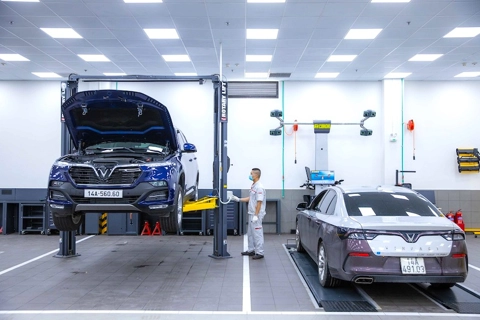
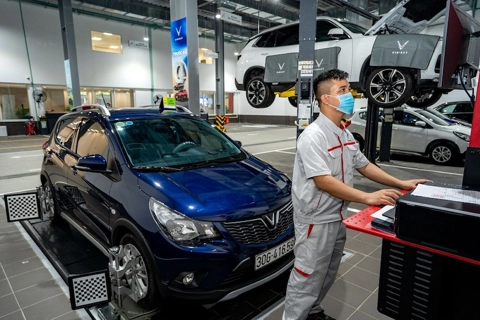
This was one of many proposals of VinFast, the Vietnamese only enterprise investing in EV production in Vietnam, to remove obstacles and boost the establishment of the EV market in big cities such as Hanoi and Ho Chi Minh.
| The model of VinFast's charging stations. Photos: VinFast |

Pham Thi Thuy Duong, Director of the Center for charging stations at VinFast, recently, told the seminar “Infrastructure for Vietnam’s electric vehicles” that the company has proposed to the Government to quickly complete legal regulations and make charging stations a must-have item in the road traffic and urban infrastructure system.
Besides the Vietnamese automobile maker, some foreign brands are also starting joining the field of charging stations. Porsche has built fast charging stations in Hanoi and Ho Chi Minh City for its Taycan models while Mitsubishi or Audi are also setting up charging stations for EVs.
Vietnam has neither tax incentives nor price subsidies for EVs. In addition to import duties, electric cars shipped to Vietnam have been subject to special consumption tax rates ranging between15-70%, which increase prices by up to 20%.
Lack of charging infrastructure
EV adoption is a goal of most countries including Vietnam. However, one of the major obstacles to the adoption of EVs is battery and charging infrastructure issues, according to a consulting team from Hanoi University of Science and Technology, University of Transport who conducted the latest study on electric mobility development in Vietnam with the support of the German-based GIZ in the framework of NDC Transport Initiative for Asia (NDC-TIA).
Currently, Vietnam has no charging infrastructure for EVs while EV batteries must be charged for the vehicle to run and battery storage capacity defines the distance that can be traveled on each charge.
According to the study’s results, 60.8% of vehicle owners worry about travel distance per charge in the context in which public recharging or exchange stations are absent. Therefore, the limited range can be considered an important technical barrier and is a main concern for users.
The average EV charging time is longer than the average refueling time of conventional vehicles. According to the survey, full charging takes about 6.5 hours, much longer than conventional refueling. Fast charging with very high-power ratings of up to 350 kW could reduce the required charging time.
However, for the majority of pure battery electric vehicles (BEVs), fast charging is not seen as an important criterion due to higher costs and battery lifetime-reduction stress.
The consultant team said the long charging time for EVs is an inevitable truth, therefore, users are required to change their habits to accept it, unless a swapping/renting system like the one implemented by VinFast.
Promoting Vietnam’s EV ecosystem
| The model of VinFast's charging stations at shopping mall parking lots. |
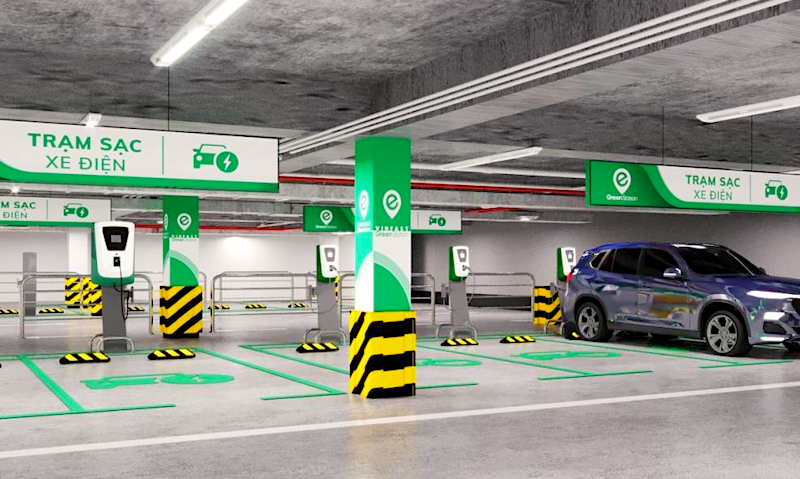
To expand its EV ecosystem, this year, VinFast will set up more than 2,000 charging stations across 63 provinces and cities with nearly 40,000 charging ports, Duong from VinFast said.
“As of June 2021, we have had nearly 700 partners in 60 out of 63 provinces and installed 455 stations with nearly 11,000 charging ports,” she said. “Super-fast charging stations with a charging capacity of up to 250kW allow to go 180km after 15 minutes of charging. It is very convenient for users.”
Truong Ba Tuan, Deputy Director of the Department of Tax Policy under the Ministry of Finance, said tax and fee solutions to promote the usage of environmentally-friendly cars has been implemented by many countries around the world in order to promote sustainable growth and reduce greenhouse gas emissions.
In particular, many countries have applied policies on exemption and reduction of some taxes and fees such as registration tax and road usage fee, he added.
Besides, to encourage the production and use of environmentally friendly cars, some countries have applied other policies such as credit support for buyers.
Duong emphasized that Vietnam needs to catch up with world trend promptly, since further delay would result in a missed opportunity for Vietnam’s EV industry.
Obviously, the trend of EVs is becoming more and more real and creating favorable conditions for it to develop is an important requirement that should be met soon, local insiders said.