Vietnam to allocate US$35 billion for economic recovery plan 2022-2023
Successful realization of the program would help boost economic growth in the 2021-2025 period to 6.4-6.8%, one percentage point higher than a scenario without the program.
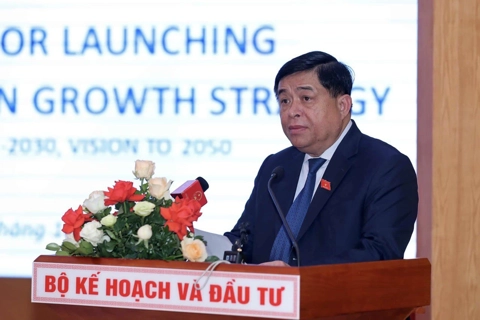
The Ministry of Planning and Investment (MPI) has proposed the allocation of VND800 trillion (US$35 billion) for the economic recovery plan in the 2022-2023 period, a 3.5-fold increase compared to the provisions to existing programs this year.
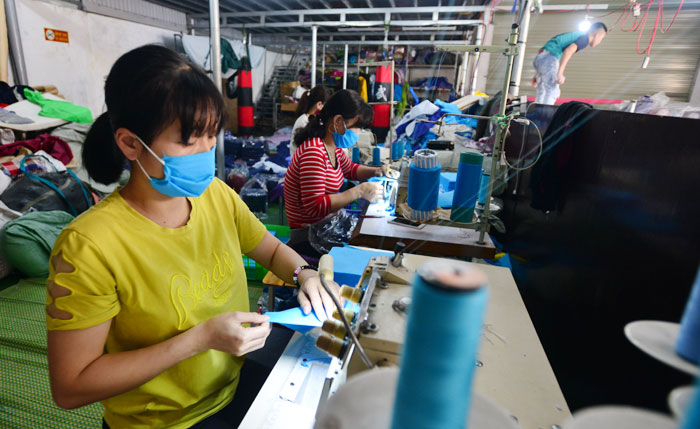
| A garment factory in Dong Anh District, Hanoi. Photo: Chien Cong |
According to the MPI, the Covid-19 pandemic has wreaked havoc globally and forced many countries to put into effect large-scale stimulus packages, such as the US (27.9% of the GDP), Japan (44.8%), Thailand (15.6%), Malaysia (8.8%), or China (6.1%).
“Such measures are unprecedented but the general consensus is the necessity to accept higher public debt to have the resources to fight the pandemic and aid economic recovery,” noted the MPI.
The ministry noted in the case of Vietnam, despite the efforts from the Government to support businesses and people affected by the pandemic, the size of current programs remains relatively low at $10.5 billion, or 2.85% of the GDP.
“These programs mainly address issues from the supply sides, and have not been able to provide substantial support for the businesses and people, as well as the lack of an overall plan to push for recovery from both the supply and demand sides of the economy,” it continued.
Without sufficient support, the MPI said the economy would not be able to recover, eventually impacting the state budget, the finance-monetary market, labor force, or social security.
Meanwhile, Vietnam may face the risk of missing opportunities from the global economic recovery in the post-pandemic period.
“In that case, Vietnam would not be able to realize its yearly, five-year, or 10-year development goals, and lag further behind regional and international countries,” said the MPI.
Set to take place in the 2022-2023 period, the program would consist of four components, including an overall program of economic reopening in association with Covid-19 prevention and control; social welfare and job creation; support for enterprises, cooperatives, and home businesses; promoting infrastructure development.
Specific measures consist of one-time financial support payment for poor households of VND21.2 trillion ($943.3 million); one-time support payment for a low-income group of VND12 trillion ($528.7 million); support for enterprises and business households in the forms of lower taxes and fees worth VND370 trillion ($16.3 billion); infrastructure development of VND220 trillion ($9.7 billion).
Funds for the program would be mobilized from state budget savings; Government bonds; foreign reserve funds and off-budget financial funds if necessary; loans from international financial institutions such as the World Bank, International Monetary Fund, Asian Development Bank.
Time is essential
According to the MPI, successful realization of the program would help boost economic growth in the 2021-2025 period to 6.4-6.8%, one percentage point higher than a scenario without the program.
In addition, the public debt would be around 47% of the GDP in 2022 and 49% in 2023. For the 2016-2020 period, Vietnam’s fiscal deficit was estimated at 3.6% of the GDP, lower than the target of 3.9%.
Other key indicators of public debt at 55.3%, Government debt at 49.1%, and foreign debts at 47.3% all stay below their respective limits of 65%, 54%, and 50%.
“Vietnam still has room to expand the public debt and fiscal deficit to support the economy against the pandemic,” Economist Tran Hoang Ngan told The Hanoi Times.
Economist Vo Tri Thanh said drawing from the experience of the past support programs, the most significant issue is to implement the program in an effective and timely manner for businesses to recover.
“The Government should take drastic steps to accelerate administrative reform and build e-government, along with a mechanism to promote new economic models with the presence of Fintech or AI,” he told The Hanoi Times.
Vice Director of the Central Institute for Economic Management (CIEM) Phan Duc Hieu suggested it would be ideal if the program is “put into effect in 2021”, noting this would send a strong message for investors and businesses so that they are settled for long-term operation in the country.
Vice Minister of Planning and Investment Tran Quoc Phuong said the economic recovery plan would focus on providing direct support for all business components, as the policies would address issues from both the supply side (credit provision, labor force), demand-side (promoting consumption and acceleration of public investment), and distribution network (transportation or logistics). Fields that have high potential to recover after the pandemic would receive support, including tourism, hospitality and catering services, manufacturing and processing, agro-forestry-fishery, or those with high competitiveness in the long-term of e-commerce, digitalization, or digital economy. |