Vietnam vows to become transparent food producer
Vietnam said a transparent agricultural market would be suitable for local people and reliable for importers.
Vietnam has stated its goal to become a transparent – responsible – sustainable food producer and supplier that can meet the demand for food security and nutrition of about 100 million Vietnamese people and export.
| Participants at the event held in Danang on Oct 12, including Dina Umali-Deininger, Agriculture and Food Practice Manager for the East Asia and Pacific Region of the World Bank (3rd from left), Deputy Minister of Agriculture and Rural Development Le Quoc Doanh (3rd from right), Rémi Nono Womdim, FAO Representative in Vietnam (2nd right). Photo: FAO Vietnam |
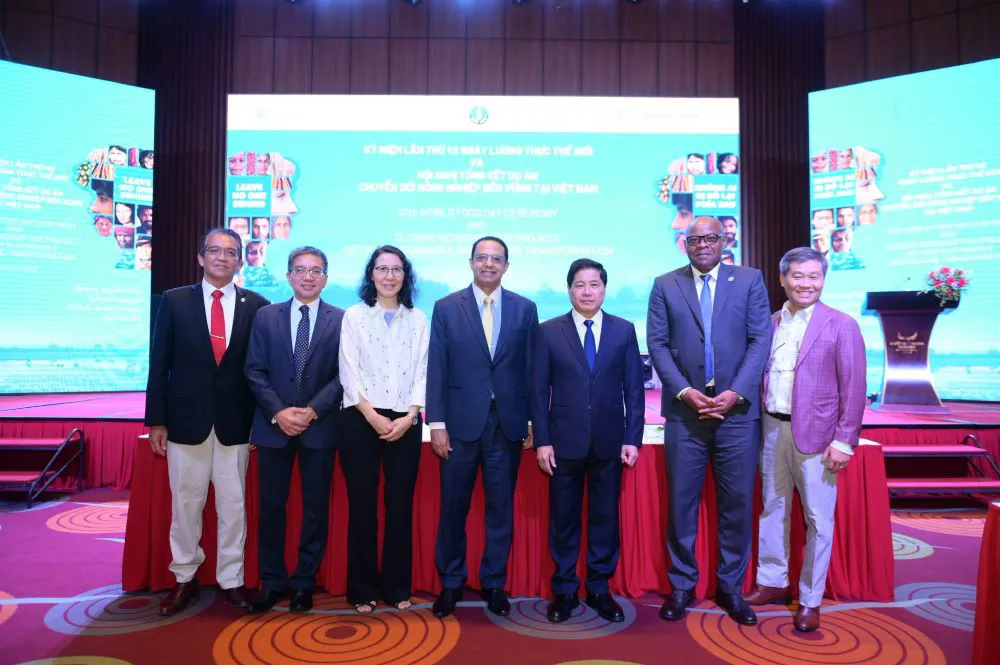
Deputy Minister of Agriculture and Rural Development (MARD) Le Quoc Doanh shared the idea at a meeting to celebrate the 42nd World Food Day (WFD), and the closing workshop for the World Bank-funded Vietnam Sustainable Agriculture Transformation Project (VnSAT) held in Danang on October 12.
“Ensuring equal access to safe and nutritious food is an important element in sustainable development, especially for the poor and the vulnerable, who are suffering the most from the epidemics, natural disasters, wars, and economic recession,” Doanh made the statement at the ceremony attended by Rémi Nono Womdim, FAO Representative in Vietnam, and Dina Umali-Deininger, Agriculture and Food Practice Manager for the East Asia and Pacific Region of the World Bank.
Doanh gave the idea that this year’s World Food Day, themed “Leave no one behind. Better production, better nutrition, a better environment, and a better life”, provides an opportunity to engage a broad spectrum of stakeholders on the need to transform food systems.
He said Vietnam’s efforts align with the global trend to ensure that every person has access to adequate food and nutrition while protecting the environment, conserving natural resources, and responding effectively to climate change.
Regarding the World Bank-funded “Vietnam –Sustainable Agricultural Transformation” (VnSAT) Project, implemented from 2015 to 2022 in 13 provinces across the country, the project enhanced the institutional capacity of the agriculture sector, introduced and scaled up innovative, sustainable, and low carbon farming methods, and improved the value chains for the rice and coffee sub-sectors.
Making significant contributions to operationalizing the Scheme on Agricultural Restructuring, the project positively impacted economic performance, such as improving farmer productivity and the quality of rice and coffee. It also delivered positive environmental and social impacts.
“VnSAT has not only helped to improve farming efficiency, increase farmers’ incomes, and reduce environmental pollution but also contributed to the reduction in agriculture GHG emissions, amounting to over 1.5 million tons CO2e from rice farming annually. This successful model can be a springboard to scaling it up to other regions of the country, as MARD pursues the green agricultural transformation in Vietnam,” said Dina UmaliDeininger, Agriculture and Food Practice Manager for the East Asia and Pacific Region of the World Bank.
Making changes from transparent production
Rémi Nono Womdim, FAO Representative in Vietnam, said: “I strongly believe that working and sharing, Vietnam can accelerate the transformation to more efficient, inclusive, resilient and sustainable agri-food systems for better production, better nutrition, a better environment, and a better life, leaving no one behind.”
Minister of Agriculture and Rural Development Le Minh Hoan reiterated the importance of transparent production in the agriculture sector, saying that it would regain the trust of customers who are in rising demand for good products.
“A transparent farming chain which is from cultivation, production, processing, trading, to consumption is essential for Vietnam’s agriculture,” Hoan told local media, noting that a well-managed supply chain from producers to end users would help ensure products of high quality, making consumers at ease.
He highlighted transparent origin, good management of quality, and elimination of intermediate stages while emphasizing the role of connection (among farmers/producers), cooperation, and a well-managed market.
“It must be good for the domestic market, which serves 100 million Vietnamese people, then for export,” Hoan said, stating that once producers and suppliers are responsible for consumers in the domestic market, they are accountable for the export market.
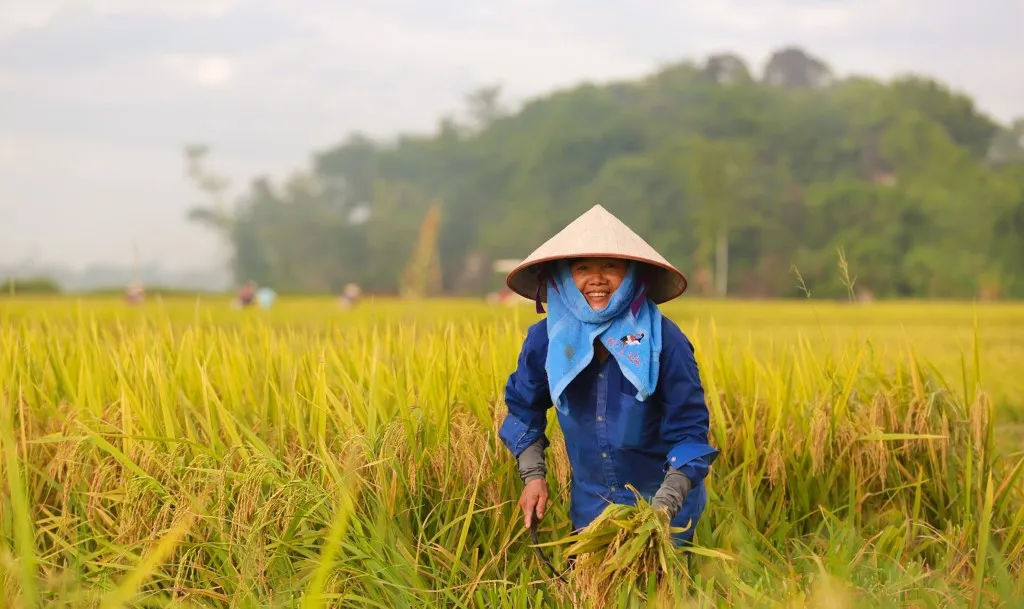
| Rice harvest in Hanoi's suburb. Photo: Khanh Huy/ The Hanoi Times |